
For MCS solar PV and battery installers
A G98 and G99 tracker that lives on the job
Every generating install needs the network operator told, and the route depends on the total. Voltfile records the route, counts the deadline and keeps the DNO proof in the job file, so the final pack cannot go out without it.
The problem
Why DNO notifications slip
A G98 notice is due after commissioning, when everyone has moved on to the next job. A G99 application has to be in, and accepted, before you install, which is easy to miss on a quick-turnaround battery retrofit.
The acknowledgement then sits in one person’s inbox, and nobody can find it when the customer’s energy supplier asks for it.
How Voltfile helps
What you get on every job
- The route from the numbersEnter the new PV, battery inverter and any existing generation. G98 is refused when the aggregate is over 16 A per phase, so the job moves to G99.
- The deadline on the Home screenG98 is counted from commissioning. For G99, an acceptance dated after the installation keeps the item open and blocks the gate.
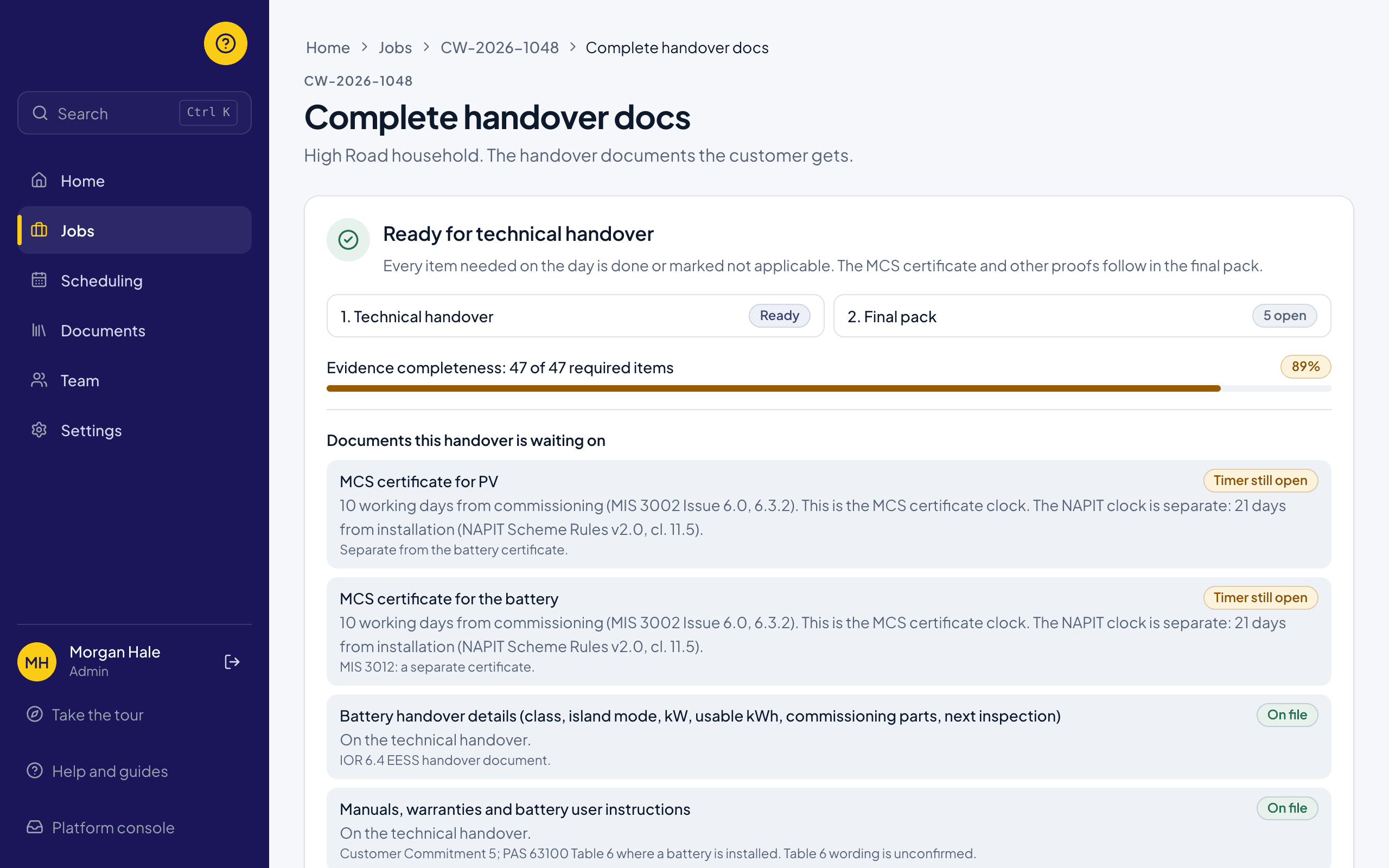
- Proof in the packThe DNO reference and acknowledgement are part of the final pack, and the homeowner can download them from the portal.
What it does not do
- The network operator decides on the application. It is sent through ENA Connect Direct, and its status is checked when you press the button, not on a timer.
- Thresholds and forms are set by the Energy Networks Association and each DNO. Check the current engineering recommendation and your DNO’s guidance.
FAQ
Common questions
What is the difference between G98 and G99?
G98 covers small, fully type-tested generation up to 16 A per phase in aggregate, where you connect and then notify. G99 covers larger or non-type-tested systems, where you apply to the network operator before connecting.
Does a battery count towards the G98 limit?
The battery’s power conversion equipment is counted with the new PV and any existing generation. Check the current guidance from your network operator for your exact setup, including export limitation.
Guides on this topic
Related
Free: the handover evidence checklist
A printable one-page-per-job PDF, from survey to final pack.